Guides
Local delivery accounts: ordinary-week test and peak checklist
Price a local delivery account from an ordinary week: cost per stop and per mile, the stop-per-mile density check, a peak checklist and named owners.
What to take away
- Price an account off cost per stop and cost per mile on an ordinary week, not off your busiest week.
- A route that averages under roughly one stop per mile rarely pays for itself; density, not volume, decides the margin.
- Match the service you sell to the vehicle, the driver hours and the proof-of-delivery you can actually staff.
- Holiday parcel volume is a staffing and vehicle problem, not a pricing problem. Book the capacity before you sign.
- Write down who owns the account, who owns the route and who takes the escalation call, by name.
Run the ordinary-week test first
An account is worth signing when its cost per stop, measured on an ordinary week, sits below what the rate pays per stop. Everything else in the offer is secondary to that comparison.
Local delivery services are sold as a stop count, a delivery window, a scan requirement and a monthly rate. What a courier can promise is narrower than what a sales sheet can describe, and that gap is where accounts go bad.
Start with a week that has no holiday, no storm and no vehicle down. Count the stops, the miles and the driver hours that week consumed. That is your production cost.
Cost per stop inputs
- Sstops completed
- Mmiles driven
- Cblended cost per hour
- Hdriver hours
Cost per stop is total route cost divided by stops completed. Cost per mile is the same total divided by miles driven. Both need the same three inputs: driver pay, vehicle cost and the loaded time between stops.
Work the arithmetic in your own figures. If a route runs S stops over M miles at a blended cost of C per hour and H hours, cost per stop is (C x H) / S. Then follow four steps:
- Count stops, miles and driver hours for one ordinary week of the route.
- Divide the total route cost by stops, then by miles.
- Repeat for three ordinary weeks before you quote anything.
- Compare the result with what the account's rate pays per stop, using the guide on how much to charge.
Check density, then match the vehicle
Density decides whether an account works, and it can be read from the same week of figures. A route with one stop every four miles burns the same hours as a route with four stops in a mile. The second one pays.
That is why the rule of thumb is about stops per mile rather than stops per day. A long list of stops spread over a wide area reads well on a sales sheet and badly on a driver's clock.
Match vehicle to service model
Cargo bike
- Stop density
- dense urban
- Leg length
- short windows
- Equipment
- insulated bag
Van
- Stop density
- bulky parcels
- Leg length
- longer legs
- Equipment
- scanner
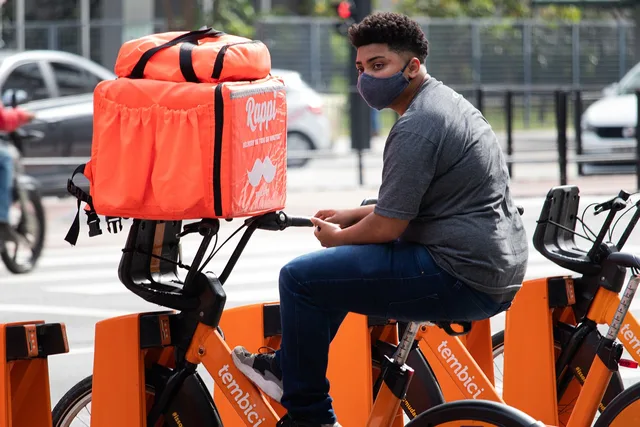
The offer also has to match the vehicle and the driver. A cargo bike covers dense urban stops and short windows. A van covers bulky parcels and longer legs. An insulated bag and a scanner are equipment decisions, not marketing lines.
The vehicle also sets the duties that come with the freight. For interstate freight, cargo securement rules set the performance standard for tying down loads. The FMCSA cargo securement rules at 49 CFR Part 393 state the general duties and the provisions for roll-on, roll-off and hook-lift containers. Confirm whether they apply to your vehicles and your lanes.
Driver pay structure changes what you can promise. Hourly pay absorbs delays. Per-stop pay punishes them, because a late stop still counts as one stop. W-2 and 1099 arrangements carry different cost and paperwork, and the IRS decides worker status with the common-law factors set out in Rev. Rul. 87-41; Form SS-8 is how you ask it for a ruling. Ask a CPA before you build a rate card on either.
Set a service standard you can hit on your worst ordinary day, not your best. If the promise is a two-hour window, staff the route so a two-hour window survives one blocked street.
Test the holiday peak before you sign
Holiday parcel volume is a capacity event. Retailers and consignees push stop counts up in November and December, and the same routes that worked in October stop working.
Peak capacity plan
- Driver hours
- Vehicle availability
- Dock time at consignee
- Disclose peak surcharge
- Support turnaround claims
- Do not sell unhired capacity
Three things break first in peak: driver hours, vehicle availability and dock time at the consignee. Check each one against the account before the contract is signed:
- Do you have the driver hours to cover the higher stop count?
- Is a vehicle free for each extra route, not borrowed from another account?
- Do the consignee's receiving hours leave room for longer dock time?
- Is any peak surcharge written into the offer and disclosed?
Peak pricing is normal in this trade, and Section 5 of the FTC Act governs how you describe it. A peak surcharge must be disclosed, and under the FTC's advertising guidance, advertising must be truthful and non-deceptive, so any claim about turnaround has to be one you can support.
Do not sell peak capacity you have not hired. A missed peak window costs more than the account is worth, and the people who make a peak work are found through hiring and training, not at the last minute.
A worked example: a retailer account that looked profitable
A courier signs a retailer with 40 stops a day across 55 miles. The rate is a flat monthly fee. On paper the account covers cost.
Run the ordinary week. Forty stops over 55 miles is under one stop per mile. Driver hours land near nine a day once loading and dock time are counted. Cost per stop comes out above what the flat fee pays.
The fix is not a rate increase. Consolidate the stops into two tighter zones, and the density does the work.
Move the far cluster to a second route that also serves a nearby consignee, and the same 40 stops fit inside seven hours. That is the same discipline behind scheduling routes without delays: fewer miles, more stops, fewer hours.
Before you rebuild the zones, decide who will actually run them, because a redesigned route collapses the first week a driver calls out if nobody is ready to cover it.
Name the owners before the first pickup
Every account needs an owner on each side. On yours, that usually means the account manager, the dispatcher, the route planner and the fleet lead. The operations supervisor takes escalations the account manager cannot settle.
Escalation path
- Driver reports late route
- Dispatcher checks route status
- Account manager contacts customer
- Operations supervisor takes unsettled escalations
On the customer side, name the person who books volume and the person who signs for parcels at the dock. Consignee receiving hours are a common source of failed deliveries, and they change without notice.
Write the escalation path down. Who calls whom, at what hour, when a route is running late. If nobody owns that call, the driver owns it by default, and the driver is the least able to fix it. Keep proof of delivery, scan timestamps and exception notes for every stop, because they are the evidence behind every claim. Put the same names into the contract terms so the account and the courier read one document.
For how accounts are bundled into services in the first place, see the guide to bundling local delivery services.
Common questions
How many weeks of figures should I use before quoting?
Three ordinary weeks, not one. A single week can hide a blocked street or a short route, and three show what the account costs on a normal day.
Should I take holiday parcel volume I cannot staff?
No. Peak volume needs driver hours, vehicles and consignee dock time booked before you accept it. A missed peak window costs the account and the reputation, and peak surcharges only help if the service holds.
What if an account fails the ordinary-week test?
Look at density before the rate. As the retailer example shows, consolidating the stops into tighter zones can fix cost per stop where a higher rate would not.
Who handles a late route at the account?
The escalation path decides it. Name who calls whom and at what hour. If nobody owns the call, it falls to the driver by default.