Guides
Keeping the books in a local delivery business: what to record and when
Courier bookkeeping runs on records tied to routes and stops, so learn what to log at pickup, at drop, and at month end, and when each entry is due.
What to take away
- The records that matter in a courier business are the ones tied to a route, a stop or a vehicle, because those are the units you price and pay from.
- Log each record at the moment the work happens, not at month end. A delivery log written from memory on Friday is a guess.
- Keep a driver settlement sheet per pay period, a route cost sheet per route, and a vehicle file per van, bike or car.
- The IRS recordkeeping guidance lists the categories to hold: income, purchases, sales, payroll, assets and supporting documents.
- If a record cannot answer "which route, which stop, which vehicle", it is not doing bookkeeping work.
What to record, and when
At booking, before the driver leaves. Capture these details:
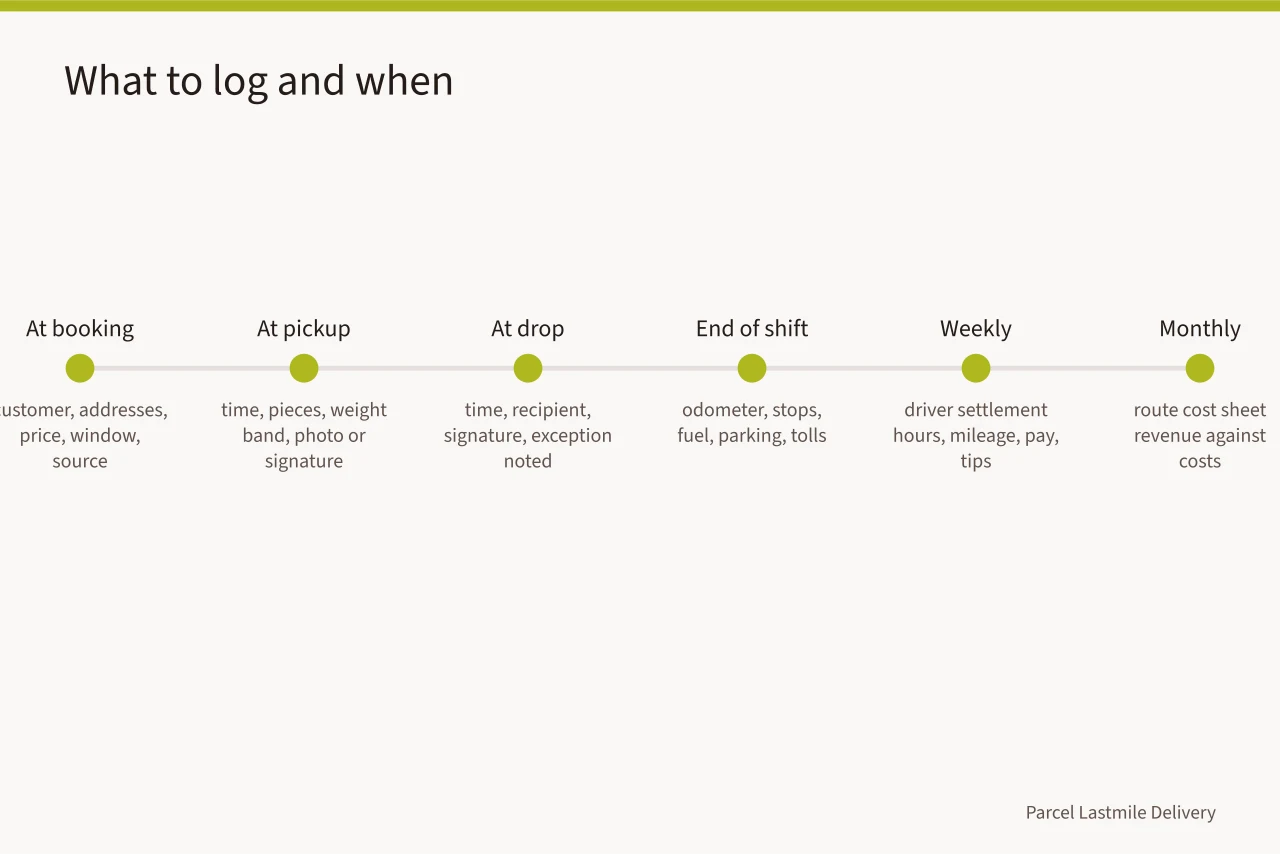
At pickup. Time, piece count, weight band, and a photo or signature. Weight band matters because a parcel billed at two pounds and carried at nine is a margin leak you will never find later.
At drop. Time, recipient name, signature or photo, and any exception. Exceptions include:
- no one home
- refused
- damaged
- redelivered Exceptions are the raw material of claims, so record them the same day.
End of shift. Odometer or trip distance, stops completed, stops failed, fuel or charge cost, parking and toll receipts. A driver who logs this at the pump gets it right. A driver who logs it Sunday does not.
Weekly. Driver settlement sheet covers hours or stops, mileage, pay rate, and tips. It also covers deductions and reimbursements. If the driver is a 1099 contractor, this sheet is what your 1099-NEC is built from at year end. The IRS publishes which records support that filing, and worker classification is a question for a CPA, not for a template.
Monthly. Route cost sheet: revenue for the route against consumables, fuel, driver pay, vehicle cost and a share of fixed overhead. This is the sheet that tells you which routes earn and which ones only look busy.
Quarterly. Estimated tax set-aside, insurance premium checks, and a review of any contract approaching renewal. Schedule C treatment and quarterly estimates are CPA territory.
Vehicle file per unit:
- purchase or lease
- insurance
- maintenance
- tires
- repairs
- the odometer reading at year end Mileage and depreciation both live here.
Cost lines in a courier business
| Cost line | How it behaves | What to watch |
|---|---|---|
| Fixed overhead (depot, insurance, software) | Sets the floor the month must clear | Commitments signed in a strong month |
| Consumables per delivery route | Move with stop count | Supplier increases absorbed quietly |
| Driver pay | Flexes less than it looks | Unpaid load, wait and quote time |
| Vehicles | Quiet, then one large bill | A breakdown mid-route that also strands the day's remaining stops |
| Claims and refunds | Rare, then clustered | Exceptions never written down at the door |
The route cost sheet, in variables
You do not need a benchmark from another city. You need your own arithmetic, and the figures are yours to substitute.
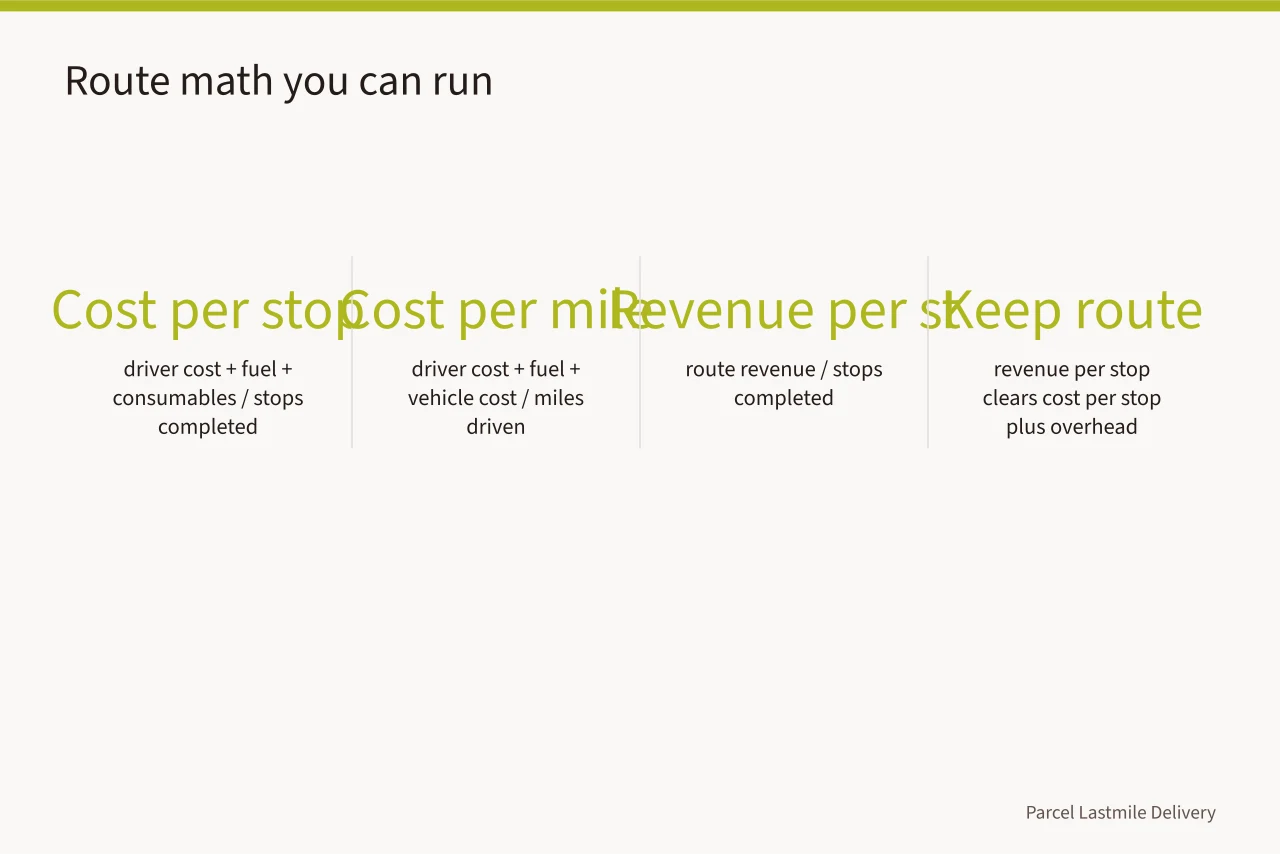
Cost per stop = (driver cost for the shift + fuel + consumables) / stops completed.
Cost per mile = (driver cost for the shift + fuel + vehicle cost for the day) / miles driven.
Revenue per stop = route revenue / stops completed.
A route is worth keeping when revenue per stop clears cost per stop by enough to cover its share of overhead and leave something. If it does not, the fix is usually route density: more stops on the same miles.
Which markets support that density is a separate question, and the markets where local delivery demand is growing is the place to check before you add a vehicle.
Records that protect the business itself
Delivery records are also security records. Customer addresses, gate codes, delivery windows and signature images are personal data, and a small courier holds a lot of it.
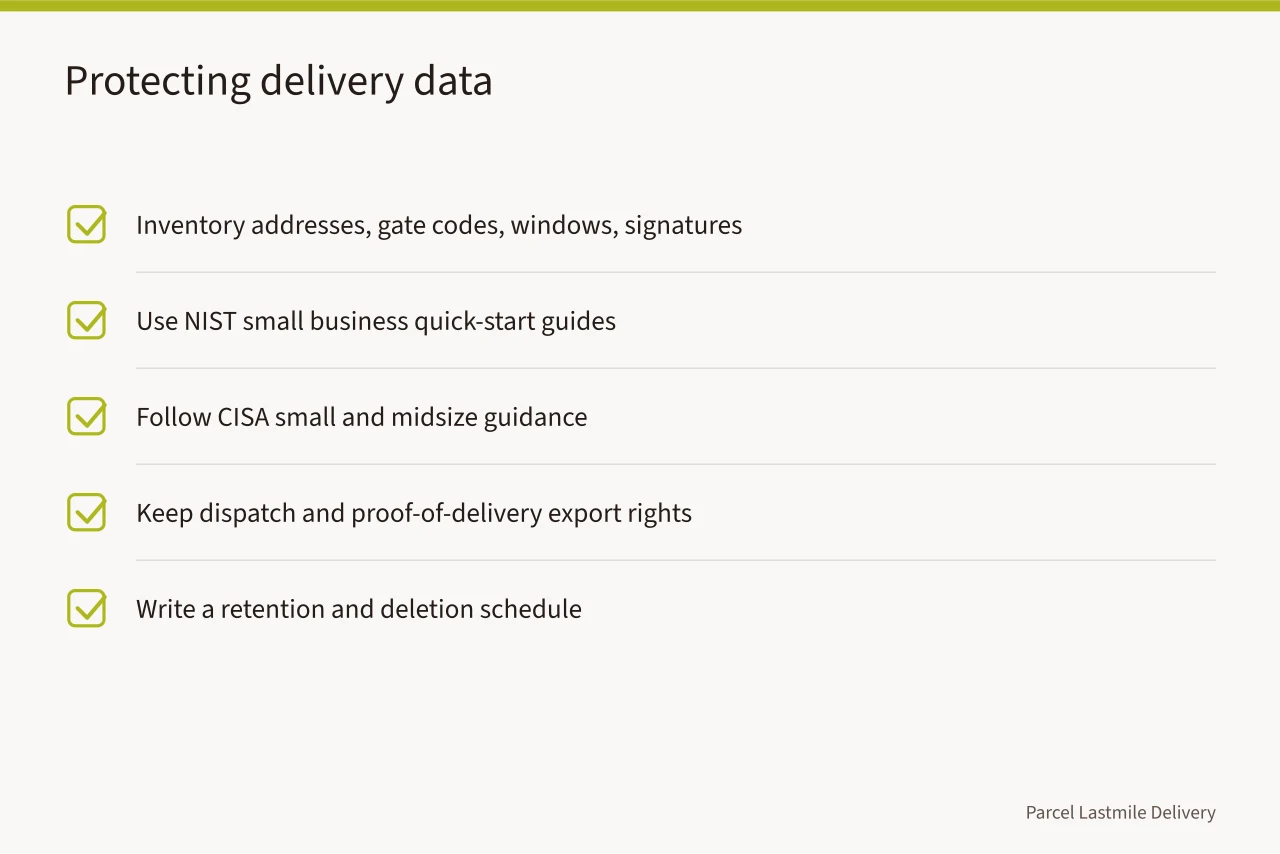
NIST publishes quick-start guides for small business cybersecurity that cover how to inventory and protect that kind of information.
CISA keeps a cyber guidance page for small and midsize businesses with current, plain-language steps.
Two practical rules follow. Keep the dispatch and proof-of-delivery system's export rights in your contract, so you can leave with your own history. And keep a written retention and deletion schedule, because a customer who asks to be erased needs an answer you can act on.
What the paperwork has to say
Your terms of service should state what you carry, what you refuse, your liability limit per parcel, your claims window, and how a disputed delivery is raised.
Carrier authority, cargo insurance minimums and courier permits are set by FMCSA, your state DOT and your city, and the exact clauses belong to a licensed attorney in your state.
For cross-border parcels to Canada, classification and duty are decided by US Customs and Border Protection, and a licensed customs broker is the right person to ask. Insurance limits and claims handling are set by your state insurance regulator; ask a licensed broker what your policy actually covers.
Common questions
How long should I keep delivery records?
The IRS recordkeeping guidance is the starting point: keep records that support income, purchases, payroll, assets and the transactions behind them, for as long as they may be needed for a return.
Many couriers hold delivery and claims records for the period their insurer and their contracts require, which can be longer.
Confirm the current retention period with your CPA.
Should drivers log stops or hours?
It depends on how you pay. Per-stop pay needs a stop count per driver per day; hourly pay needs clocked time including load and wait. Either way the settlement sheet must reconcile to the customer invoices for the same period, or you are paying for stops you never billed.
What if a vehicle breaks down mid-route?
The record is the point. Note the time, the location, the stops reassigned, the towing or repair cost, and the deliveries that failed. That single entry feeds the vehicle file, the customer claim, and next quarter's decision about whether the van is worth keeping.
Do I need bookkeeping software?
No, but you need one place where the route cost sheet lives. A spreadsheet works at three vehicles. Past that, dispatch and accounting stop matching up by hand, and the software and KPI guide for local delivery operations covers what to look for before you switch.