Guides
Reading local delivery trends before they reach your books for 2027
Five delivery trends to watch in 2027: route density, cargo bikes, quoted delivery windows, per-stop pay and cross-border parcels, and how each reaches your books.
What to take away
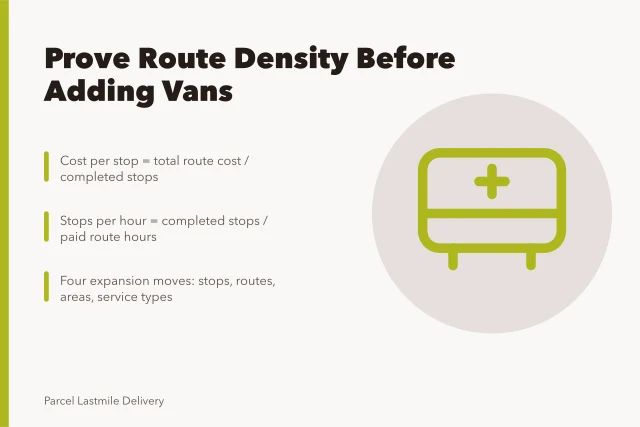
- Route density, not volume, sets your cost per stop: a 6-mile route with 40 stops beats a 12-mile route with 40 stops on every line of the books.
- Cargo bikes are winning dense urban cores where van parking is the bottleneck, not the drive time.
- Customers increasingly buy a delivery window, so a missed window becomes a service failure rather than a late arrival.
- Per-stop driver pay is spreading because it prices the work you actually sell; hourly pay hides an unprofitable route.
- Cross-border parcel paperwork for US-Canada runs is now a routine line item, not an exception.
Why these five, and how to read them
A trend only matters if it reaches your books. Each of the five below changes a cost line, a rate you can quote, or a service promise you have to keep.
Read them as questions about your own operation. The numbers are yours to fill in.
Route density is replacing total volume
The headline number most couriers chase is parcels per day. The number that pays the bills is stops per mile.
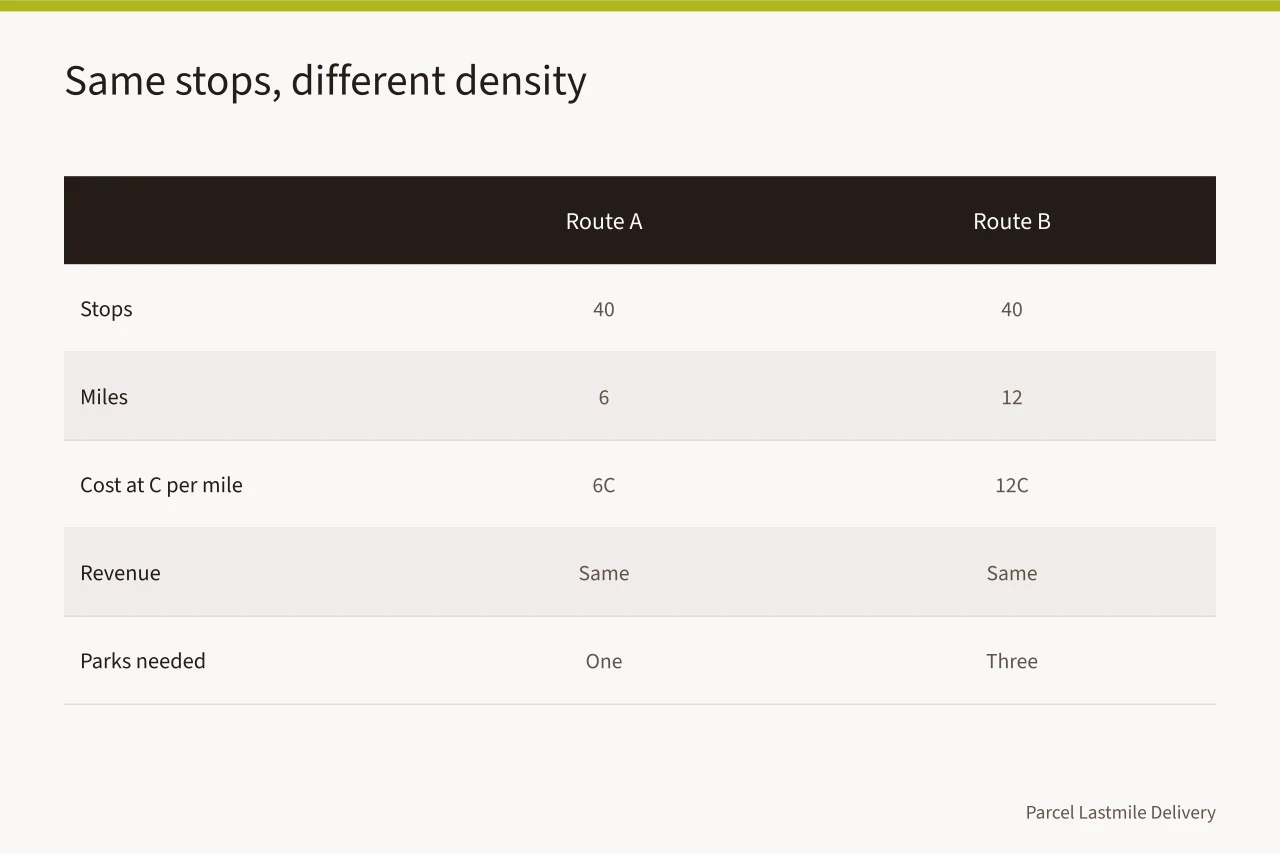
Take two routes with the same 40 stops. Route A runs 6 miles, Route B runs 12. At a cost of C dollars per mile, Route A costs 6C and Route B costs 12C for identical revenue. Density, not volume, is the lever.
Density also sets your stop sequence. A tight cluster lets a driver walk three stops from one park; a scattered route forces three separate parks and three separate parking risks.
Cargo bikes are taking the dense urban core
In downtown cores, the van is not slow because of traffic. It is slow because of parking. A cargo bike removes the park-and-walk step entirely.
That is why bike courier licensing exists as its own permit category in cities like Portland and Seattle. It is also why a bike fleet changes your insurance mix: commercial auto gives way to cargo and general liability cover.
Check what your state insurance regulator requires and confirm cover with a licensed broker before you buy a bike. The vehicle choice is yours; the coverage rules are not.
Customers are buying a delivery window, not a delivery
The shift is from "arrives today" to "arrives between 2 and 4." That turns a late parcel into a broken promise, which costs more than a slow one.
A quoted window forces you to price the promise. If a two-hour window needs a dedicated run, the rate has to carry that run, not the average route.
Track your on-time rate inside the window, not against the day. The gap between the two is the number your account manager needs.
Per-stop pay is spreading through driver compensation
Hourly pay rewards time on the road. Per-stop pay rewards stops completed. On a dense route the two diverge sharply.
If a driver earns W dollars per stop and completes S stops, gross pay is W times S. That formula makes an unprofitable route visible the day it runs, not at month end.
Worker classification is a separate question from the pay structure. The IRS sets the tests; confirm your setup with a CPA or enrolled agent, and check current wage estimates at the Bureau of Labor Statistics before you set a rate.
Cross-border parcels are now a routine line
US-Canada parcel runs used to be a specialty. They are becoming a standard service line for couriers near the border.
Customs paperwork is the barrier, not the driving. Classification, duties and clearance are CBP territory, and a licensed customs broker handles them.
Do not guess at a classification to win a quote. Build the broker's fee into the rate instead.
What to weigh before you commit
| What to compare | Why it matters for a local courier business | Common mistake |
|---|---|---|
| Fit to the delivery route | A tool built for another trade fights the delivery route every day | Trusting a demo over a trial on a real delivery route |
| Support when it breaks | Downtime through holiday parcel volume costs more than the purchase | Assuming the seller services what they sell |
| Cost over the whole life | Financing terms change the real cost | Forgetting training time |
| Whether people will use it | A local courier business runs on habit under pressure | Skipping the trial period |
| How hard it is to change later | The retailer or consignee notices a disruptive switch | No export of records |
The cargo securement rules are the clearest example of fit. The FMCSA cargo securement rules cover interstate loads, including roll-on, roll-off and hook-lift containers. Whether they reach your vehicle and route is a question for the FMCSA and a licensed attorney, not a guess.
Where to check the ground before you invest
The SBA business guide covers planning, launch, management and growth.
It includes the following:
- Market research
- Startup costs
- Permits
- Insurance
- Hiring Use it to size a new service line before you quote it.
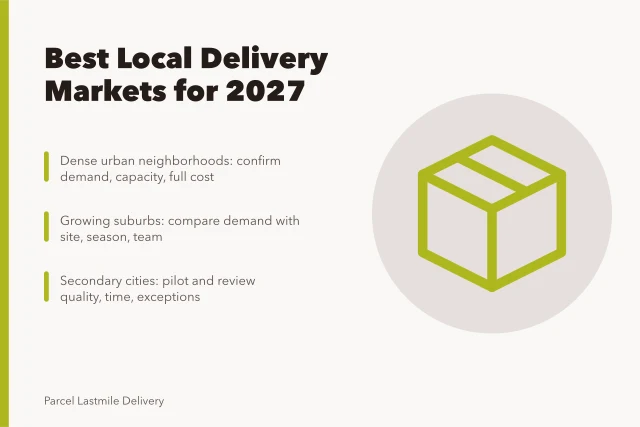
For a market-by-market view of where delivery demand is thinning or thickening, see best markets for a local delivery business in 2027.
Common questions
Which of these trends should I act on first?
Route density, because it changes every other number. A dense route lowers cost per stop, shortens the driver's day and makes a quoted window easier to keep.
Do cargo bikes replace vans?
No. They replace vans on dense urban routes where parking, not distance, is the constraint. Keep vans for the suburban and bulk work.
Is per-stop pay legal?
The pay structure is a business choice; worker classification is a separate legal question. The IRS sets the tests, so confirm your setup with a CPA or enrolled agent.
How do I price a cross-border parcel run?
Start with the broker's fee and the clearance time, then build your rate around them. Classification and duties are CBP matters, so use a licensed customs broker rather than estimating.