
Guides
Medical courier HIPAA compliance for local delivery businesses
Medical courier HIPAA compliance checklist: signed business associate agreements, state pharmacy rules, and written safeguards before lab or pharmacy work.
What to take away
- This medical courier HIPAA compliance checklist requires a signed BAA before the first medical run.
- Federal HIPAA, state pharmacy board, municipal, and private rules each apply.
- Prepare written driver instructions, a breach response plan, and required state credentials.
- Skipping a BAA can bring civil money penalties and contract loss.
Who has jurisdiction
Four layers apply to medical couriers.
| Layer | Enforcement body | What it controls | How a courier learns about it |
|---|---|---|---|
| Federal HIPAA | HHS Office for Civil Rights | Protected health information | Client BAA and HHS guidance |
| State pharmacy board | State board of pharmacy | Prescription drug handling and delivery permits | State board forms and inspections |
| Municipal | City or county clerk or police | Local commercial vehicle and delivery permits | Business license office or city code |
| Private facility | Hospital, pharmacy, or lab | Site-specific training, badges, and access rules | Client vendor onboarding |
The HIPAA Privacy Rule defines protected health information and applies to a courier that moves patient names, lab specimens, or prescription labels. State pharmacy boards require permits for prescription drug delivery. Municipal codes add local vehicle or business permits. Private facilities impose site training and badges.
The stricter layer controls the delivery when two layers conflict.
What triggers a permit
A state pharmacy delivery permit is triggered when a courier possesses prescription drugs for delivery. A HIPAA business associate agreement is triggered when a covered entity gives protected health information to the courier, such as a patient-labeled prescription bag or a lab requisition.
HHS guidance describes a courier as a business associate when the delivery service handles PHI under a service contract. A generic office supply delivery to a medical building does not trigger either requirement.
For operational basics that HIPAA builds on, use the local delivery team training checklist that owners reuse.
What to submit
Some documents stay internal, and some are submitted to the state or the client. Prepare all of them before the first medical run.
- Signed business associate agreement with each covered entity client.
- State pharmacy board license or permit if the state requires one for prescription delivery.
- Municipal delivery permit or local business license for the city where the work occurs.
- Driver confidentiality and breach notice acknowledgment, signed by each driver.
- Written breach response plan naming the person who contacts the client within 24 hours.
If you capture proof of delivery on a phone or tablet, the HIPAA Security Rule applies to that electronic protected health information. Keep device access limited and include the device in your written safeguards. A written policy should state who may access patient data and what to do if a bag is lost. Some states also want a copy of your commercial auto insurance rider and a list of drivers with valid licenses.
The same discipline that keeps local delivery contract terms clear also applies to a BAA. Do not sign a form that omits return, disposal, or breach notice duties.
How long approval takes
State pharmacy board timelines vary widely. Some states issue a same-day temporary courier registration; others require a completed background check and can take 30 to 60 days. Municipal permits often take 10 to 20 business days after a complete application.
Build the longest realistic timeline into your launch plan. Ask the state board and the city clerk for a written processing time before you quote a start date. Do not accept a first medical run on the assumption that a pending application will be enough.
Some cities require a separate pharmacy delivery endorsement even when the state permit is pending. Keep both applications moving at the same time. A courier that waits for the state permit before filing the city form can lose two weeks for no reason.
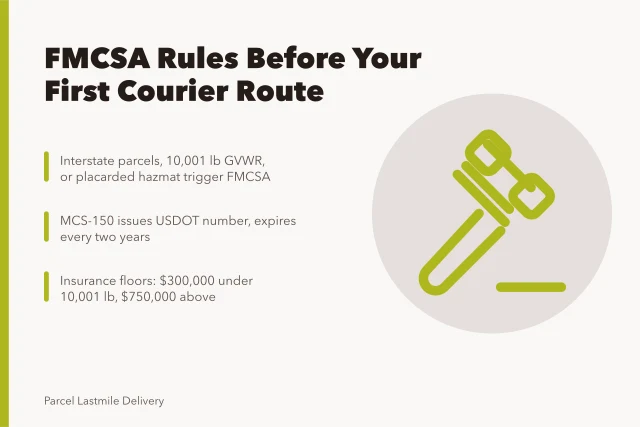
Medical courier work also inherits federal motor carrier rules, and the FMCSA rules for courier fleets explain which vehicles and drivers must comply before the first route.
What happens if you skip it
A skipped business associate agreement does not stay quiet. The Office for Civil Rights can investigate after a patient complaint or a client audit. Penalties can include a civil money penalty that accrues per violation, not per driver.
State boards of pharmacy can suspend or revoke a courier's permit after an inspection. A hospital or pharmacy can terminate the contract for cause and report the courier to its network. In a breach event, operating without a BAA usually makes the violation willful, which increases the enforcement risk.
HHS can require a corrective action plan and monitor the courier for several years. That plan often includes retraining drivers, documenting every PHI handoff, and reporting to the client monthly. A state board can also publish an enforcement action, which local hospitals see during vendor review. Losing one pharmacy contract often leads to losing others in the same referral network.
If drivers are misclassified as independent contractors, the IRS Schedule C and 1099-NEC rules can change who is responsible for a signed BAA.
Common questions
Is a medical courier always a HIPAA business associate? No. The courier is a business associate only when a covered entity gives it protected health information to perform a service. Moving generic supplies or sealed equipment without patient data does not trigger HIPAA.
Which state agency handles pharmacy delivery permits? The state board of pharmacy is the usual agency. Some states house it under a department of health or a professional licensing division, so check the board's website for courier-specific forms.
Can one business associate agreement cover multiple pharmacy clients? Not automatically. Each covered entity must have its own signed BAA unless a group practice or management organization signs on behalf of several locations.
Does HIPAA apply to medical couriers in Canada? No. HIPAA is a U.S. federal law. Canadian medical couriers follow provincial health privacy laws and pharmacy college rules, which differ from HIPAA.