
Guides
Delivery driver contractor or employee: the test that decides
Delivery driver contractor or employee status hinges on IRS common-law factors and state ABC tests. Misclassification can trigger back taxes, penalties, wage claims.
What to take away
- The IRS common-law test decides federal contractor or employee status for U.S. delivery drivers.
- State ABC tests, especially California ABC, can classify a driver as an employee even when a federal test would not.
- Misclassification can trigger IRS employment tax liability and DOL back wage claims.
- Written contracts and 1099s alone do not create contractor status; actual control matters.
Who has jurisdiction over delivery driver status
Three layers decide whether a U.S. delivery driver is a 1099 contractor or a W-2 employee. The IRS applies common-law factors for federal employment tax. The U.S. Department of Labor enforces the FLSA with an economic reality test. State agencies can impose stricter tests. California uses the ABC test for many wage claims.
Municipal permits and private contracts do not override these statutory tests. A private agreement that calls a driver an independent contractor is one piece of evidence. It cannot make the driver a contractor if the actual working relationship shows employee control.
Owners who ask about the IRS 20 factor test delivery driver rules should read the current grouping. The IRS no longer publishes a standalone 20-factor list. It folds those factors into behavioral control, financial control, and relationship type. The IRS groups these categories on its independent contractor page.
| Control area | What it asks about | Red flag for employee status |
|---|---|---|
| Behavioral control | Does the business direct how, when, and where the driver works? | Required uniforms, scripts, or mandatory dispatch times. |
| Financial control | Does the driver bear unreimbursed costs and have opportunity for profit or loss? | Company pays for fuel, insurance, and vehicle maintenance. |
| Relationship type | Is there a written contract, benefits, or an indefinite engagement? | No contract, paid hourly, or benefits provided. |
State registration is separate from worker status. See which US delivery markets need local courier authority, a state guide.
What triggers a classification review
A classification review can start with a driver complaint, an unemployment insurance claim, or an IRS employment tax audit. A state labor department may open a case after a driver files for benefits and the business reports no wages. A private lawsuit for overtime or expense reimbursement can also force the issue. For a delivery business, the approval that matters is the determination that a driver can be paid as a 1099 contractor.
The common trigger is control. If drivers must follow delivery windows, wear uniforms, use company routing software, or accept every dispatch, the relationship looks more like employment. IRS guidance on common law rules explains that no single factor is decisive.
The IRS looks at the entire relationship, not a single factor.
But if the business directs the core parts of the job, a 1099 label will not survive. That is true even when drivers own their vehicles.
What to submit if you rely on 1099 status
If a delivery business treats drivers as 1099 contractors, it should keep records that support that decision. The records do not win the argument by themselves, but they show the intended structure. Useful documents include:
- A written service agreement that describes the driver's independent business and does not prescribe a fixed daily route.
- Invoices or pay records showing payment by job or delivery, not by the hour.
- Evidence that the driver can work for other companies and chooses when to accept work.
- Copies of Form 1099-NEC for each driver and proof of the driver's own business registration where relevant.
But these documents must match reality. An IRS auditor will compare the paperwork with what drivers actually do. If the business requires drivers to appear at 7 a.m., supplies the vehicle, and pays a flat hourly guarantee, the documents will not protect the contractor label.
Local delivery contract terms can clarify scope and control, but they cannot override the common-law test.
How long a determination takes
A federal determination through IRS Form SS-8 can take six months or longer. The IRS asks workers and businesses to complete the form and submit documents. After the IRS issues a determination, it applies to employment tax liability. A state determination under California ABC test delivery rules may move faster, but it depends on agency backlog.
Businesses should not assume a delay means the worker is classified as expected. A pending case does not stop accruing liability.
What happens if you skip the test
Skipping the classification test creates concrete liability. A 1099 courier misclassification finding can lead to an IRS tax adjustment and state penalty assessments. Under IRS rules, a business that misclassifies a driver may owe the employer share of Social Security and Medicare taxes for years not filed. The IRS can add failure-to-deposit penalties up to 15 percent of the unpaid amount.
When drivers are contractors, tax reporting changes. See how IRS Schedule C and 1099-NEC rules shape US courier pay.
Under FLSA enforcement, the Department of Labor can seek back wages plus liquidated damages for drivers who were paid as contractors but worked overtime. A California ABC test delivery violation can also trigger state penalties for unpaid wages and missed meal and rest period premiums. The DOL Wage and Hour Division enforces FLSA employee status and can pursue these claims directly.
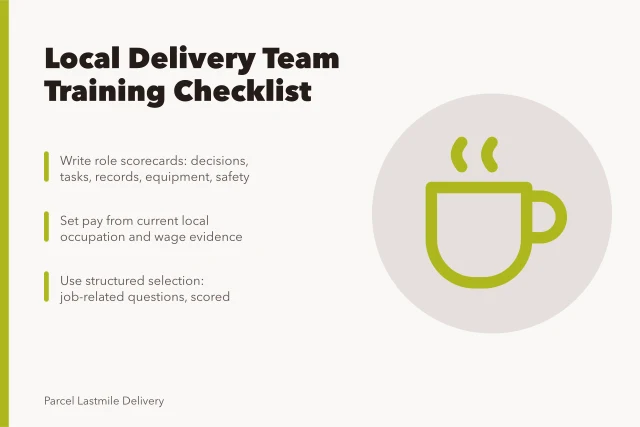
If a business converts drivers to W-2, onboarding changes. A local delivery team training checklist can help.
Common questions
Does an IRS 20 factor test still apply to delivery drivers? No. The IRS now groups the factors into behavioral control, financial control, and relationship type, but the underlying analysis is the same.
Can a written 1099 contract make a driver a contractor? No. A contract is one piece of evidence. If actual control shows employee status, the contract will not prevent reclassification.
What is the California ABC test for delivery drivers? The ABC test classifies a worker as an employee unless the business shows three things: the worker is free from control, performs work outside the usual course of business, and has an independent trade. For a delivery company, part B often fails because delivery is the usual course of business.
What is one concrete consequence of misclassification? The IRS can assess the employer share of Social Security and Medicare taxes for all affected years, plus failure-to-deposit penalties up to 15 percent.