
Guides
Break-even for a local delivery business, worked through
A one-van courier operation breaks even at a stop count you can calculate from its own fixed costs, driver wages, fuel and cost per mile driven.
What to take away
- Break-even is a stop count, not a feelingfixed costs divided by contribution per stop.
- Contribution per stop is your rate minus driver pay per stop, fuel, and the maintenance your odometer adds.
- A route that clears break-even on stops can still lose money on miles, so track both.
- Rebuild the number when fuel, insurance or your pay rate changes, not once a year.
- Anything below break-even is a decision about volume, price or the route itself.
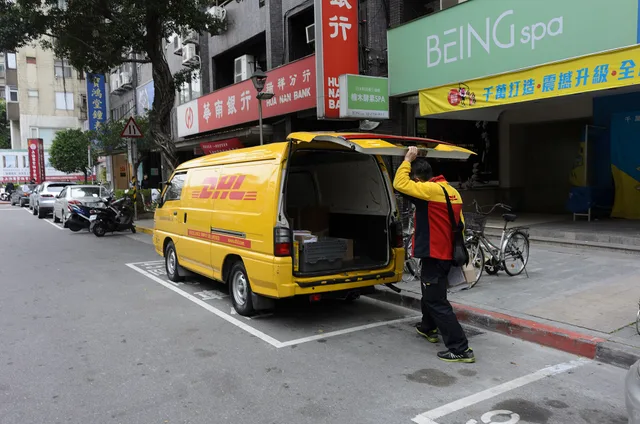
!Courier loading parcels into a van before a delivery route
The arithmetic, in named variables
Break-even answers one question: how many stops cover the bills that arrive whether you drive or not. Write it as fixed costs divided by contribution per stop.
Break-even formula
- Fixed costs divided by contribution per stop
- Rate per stop minus driver pay per stop
- Minus fuel per stop minus maintenance per mile
- Fuel per stop: price per gallon divided by MPG
- Run the division monthly, not annually
Contribution per stop is what one stop leaves behind after the costs that stop creates. Rate per stop, minus driver pay per stop, minus fuel per stop, minus maintenance per mile times miles per stop.
Fuel per stop is your price per gallon divided by miles per gallon, times miles per stop. Nothing in that formula is a benchmark. Substitute your own fuel price, your own van's economy, your own route length.
Run the division monthly, not annually. Insurance, van payment, dispatch software and garage rent do not care how busy December was.
A worked example
Take a one-van operation. Fixed costs are the van payment, commercial auto and cargo insurance, dispatch software, and a storage unit: add your own figures and call the monthly total F.
Worked example figures
- 9.00rate per stop
- 4.00driver pay per stop
- 0.49fuel per stop
- 0.30maintenance per stop
- 4.21contribution per stop
- 3,800monthly fixed costs
- 903break-even stops per month
- 41stops per day
Say the route rate averages 9.00 dollars a stop and the driver is paid 4.00 a stop. Fuel at 3.50 dollars a gallon and 18 miles per gallon costs about 0.19 dollars a mile; a route averaging 2.5 miles between stops adds roughly 0.49 dollars a stop.
Maintenance at 0.12 dollars a mile adds about 0.30 dollars a stop. Contribution per stop is 9.00 minus 4.00 minus 0.49 minus 0.30, or 4.21 dollars.
If F is 3,800 dollars, break-even is 3,800 divided by 4.21, about 903 stops a month. At 22 delivery days that is 41 stops a day.
Those figures are illustrative. Replace every one with your own before you use the answer.
Where the number breaks
The example assumes every stop is priced the same. Holiday parcel volume rarely is, and a peak week can hide a thin January.
It also assumes the van is full enough that miles per stop stay low. Route density is the lever: adding stops to an existing run spreads fuel and maintenance across more contribution.
Watch the split between fixed and variable. A 1099 driver paid per stop turns pay into a variable cost and lowers break-even, but worker classification is an IRS question with real consequences. Confirm the status with a CPA before you build a model on it.
Insurance and authority paperwork sit in fixed costs and move without warning. Check current requirements with your state insurance regulator and a licensed broker, and confirm operating authority with the FMCSA before you price a contract around them.
Pricing rows that fit a courier
Where it fits a local courier business
- Flat rate per route
- Retailers comparing quotes on a known daily run
- Per stop plus mileage
- Dense urban work with variable distances
- Per parcel, tiered by weight
- Holiday parcel volume and seasonal peaks
- Retainer or membership
- A shipper with a recurring weekly need
What it hides
- Flat rate per route
- The route that runs long eats the margin
- Per stop plus mileage
- The customer watches the odometer instead of the result
- Per parcel, tiered by weight
- The middle tier ends up carrying everyone
- Retainer or membership
- Underused agreements feel like a bad deal to the buyer
Whichever row you pick, the break-even test is the same. Convert the price into contribution per stop and compare it with F divided by that contribution.
Checks before you commit
Internal Revenue Service: What kind of records should I keep? covers the records that support the costs in your model. Keep the receipts behind fuel, maintenance, payroll and asset purchases.
Federal Trade Commission: Advertising FAQs: A Guide for Small Business applies the moment you advertise a rate or a delivery promise. Claims must be truthful and supported.
U.S. Bureau of Labor Statistics: Occupational Employment and Wage Statistics Tables publish wage estimates by occupation and metro area, one input when you set driver pay per stop.
Once the model runs, the next constraint is usually people. Hiring drivers who show up and stay is its own problem, covered in how to hire reliable staff for a local delivery business.
The rate side deserves the same care. How to price local delivery services for a fair margin walks through setting the number that feeds this calculation.
Common questions
What counts as a fixed cost in a courier break-even?
You may pay several expenses on a schedule:
- Commercial auto and cargo insurance
- General liability
- Dispatch and routing software
- Storage or garage rent
- Any permit or licensing fees These arrive whether the van moves or not. Variable costs, fuel, maintenance, driver pay per stop, scale with the work.
How often should I recalculate break-even?
Monthly at minimum, and immediately after any change to fuel prices, insurance premiums or driver pay. A model built in spring can be wrong by fall. The division takes minutes once you have the figures in a spreadsheet.
Can a route be profitable and still lose money?
Yes. If the stops clear break-even but the miles between them run long, fuel and maintenance eat the contribution. Track contribution per stop and cost per mile together. A route with fewer, closer stops often beats one with more stops spread across a county.
Does paying drivers per stop instead of hourly help?
It converts driver pay from fixed to variable, which lowers break-even and shifts risk to the driver. Whether that is lawful depends on worker classification rules set by the IRS and your state. Ask a CPA or enrolled agent before changing how you pay anyone.